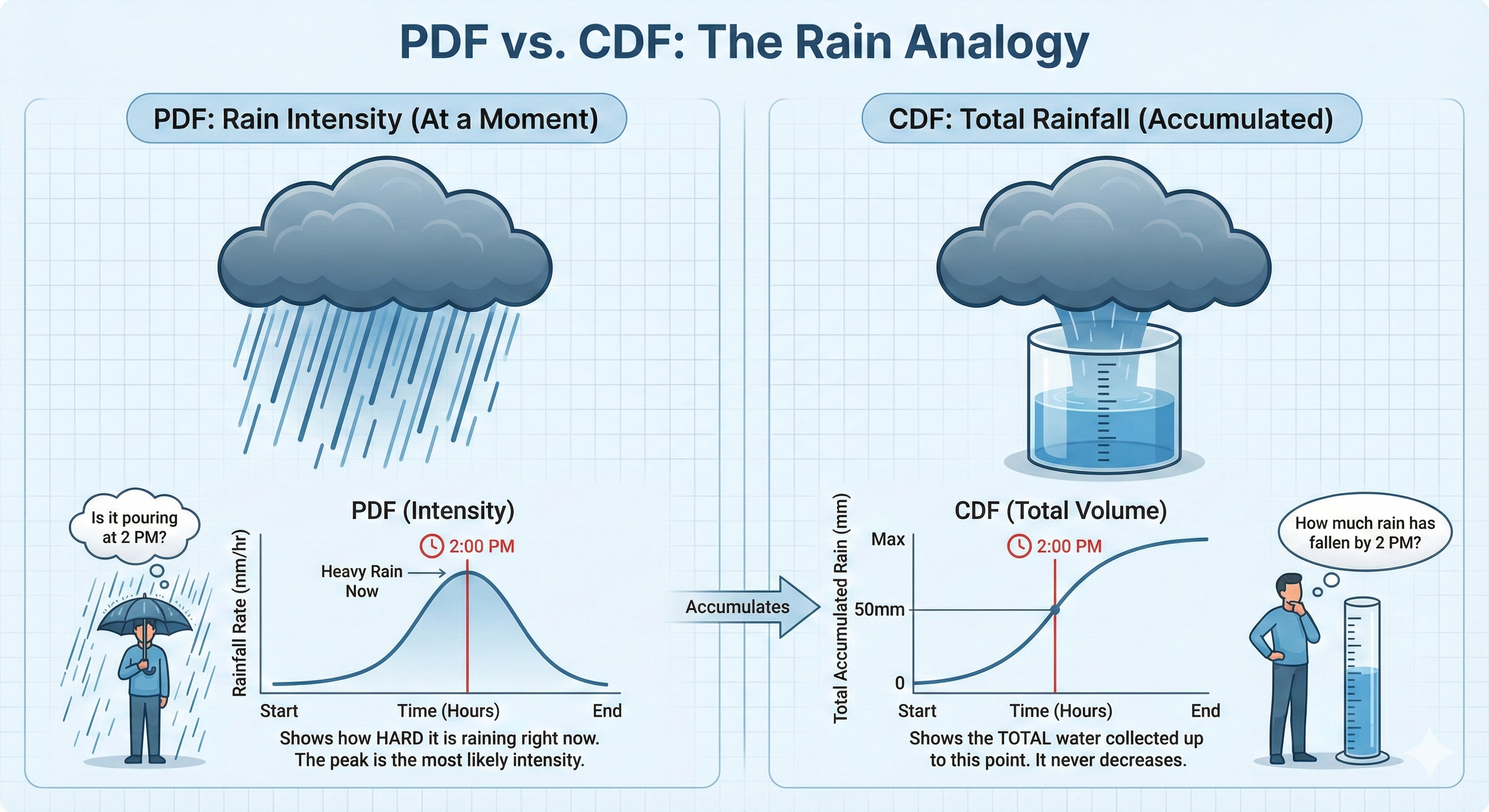
A continuous random variable can assume any value in an interval on the real line or in a collection of intervals.
It is not possible to talk about the probability of the random variable assuming a particular value.
Instead, we talk about the probability of the random variable assuming a value within a given interval.
Continuous Probability Distributions
The probability of the random variable assuming a value within some given interval from x1 to x2 is defined to be the area under the graph of the probability density function between x1 and x2.
Uniform Probability Distribution
A random variable is uniformly distributed whenever the probability is proportional to the interval’s length.
The uniform probability density function is:
\[
f(x)=
\begin{cases}
\frac{1}{b - a} \text{ for } a \leq x \leq b \\
0 \text{ otherwise}
\end{cases}
\]
Uniform Probability Distribution
The expected value of x is \(E(x) = \frac{(a + b)}{2}\).
The variance of x is \(Var(x) = \frac{(b – a)^2}{12}\).
Why can we define variance as \(Var(x) = E(x^2) - [E(x)]^2\)?
This is a useful trick for calculating variance, because it allows us to calculate the variance without having to calculate the expected value of the random variable first.
We can calculate \(E(x^2)\) and \(E(x)\) separately, and then use the formula to get the variance.
Now we can compute the variance: \[
Var(x) = E(x^2) - [E(x)]^2 = \frac{b^2 + ab + a^2}{3} - \left( \frac{b + a}{2} \right)^2 = \frac{(b - a)^2}{12}
\] :::
Example
Suppose that the time it takes to complete a task is uniformly distributed between 5 and 10 minutes.
What is the probability that the task will take between 6 and 8 minutes?
NoteSolution
The probability is the area under the graph of the probability density function between 6 and 8 minutes.
The area is the length of the interval times the height of the probability density function.
The probability is \(2 \times \frac{1}{10 - 5} = \frac{2}{5}\).
Example: Slater’s Buffet
Slater’s customers are charged for the amount of salad they take. Sampling suggests that the amount of salad taken is uniformly distributed between 5 ounces and 15 ounces. The uniform probability density function is:
\[
f(x)=
\begin{cases}
\frac{1}{15 - 5} \text{ for } 5 \leq x \leq 15 \\
0 \text{ otherwise}
\end{cases}
\]
Example: Slater’s Buffet
What is the probability that a customer will take between 12 and 15 ounces of salad?
Another way to think of the uniform distribution is that it is a “flat prior.”
In the absence of any other information, we can assume that any outcome is equally likely, just \(\frac{1}{b - a}\).
All you need is some information on some minimum and maximum values.
It’s also a way to express a simple way to randomize, giving each outcome equal weight.
Area as a Measure of Probability
The area under the graph of f(x) and probability are identical.
This is valid for all continuous random variables.
The probability that x takes on a value between some lower value \(x_1\) and some higher value \(x_2\) can be found by computing the area under the graph of \(f(x)\) over the interval from \(x_1\) to \(x_2\).
Warning
What is the probability of a continuous random variable taking on a specific value, say \(x = c\)?
Cumulative Probability
Sort of review: What is a cumulative probability distribution, vs. a probability distribution?
We talked about this with discrete random variables.
The cumulative probability distribution gives the probability that the random variable is less than or equal to a certain value.
For continuous random variables, it is the area under the probability density function up to that value.
But the PDF function, itself, shows where probability might be concentrated.
Cumulative Probability
What is the CDF of a Uniform Random Variable?
What would that look like?
Let’s draw it out.
I want to draw this on the board. We start with a uniform distribution, and then go through the process of calculating cumulative probabilities for different values of x.
start by drawing a uniform distribution between a and b.
then, for a value x0 between a and b, we calculate the area under the curve from a to x0. This area represents the cumulative probability P(X ≤ x0).
Just calculate the area of the rectangle.
\[
F(x) =
\begin{cases}
0 \text{ for } x < a \\
\frac{x - a}{b - a} \text{ for } a \leq x \leq b \\
1 \text{ for } x > b
\end{cases}
\]
Other Continuous Probability Distributions
There are many other continuous probability distributions.
They are used to model different types of phenomena.
If the uniform distribution gives us a situation with a lot of uncertainty about outcomes, other distributions make more specific assumptions about the nature of the random variable, and which outcomes are more likely.
Exponential Probability Distribution
The exponential probability distribution is useful in describing the time it takes to complete a task.
The exponential random variables can be used to describe:
Time between vehicle arrivals at a toll booth
Time required to complete a questionnaire
Distance between major defects in a highway
In waiting line applications, the exponential distribution is often used for service time.
Exponential Probability Distribution
A property of the exponential distribution is that the mean and standard deviation are equal.
The exponential distribution is skewed to the right.
The time between arrivals of cars at Al’s full-service gas pump follows an exponential probability distribution with a mean time between arrivals of 3 minutes. Al would like to know the probability that the time between two successive arrivals will be 2 minutes or less.
Relationship between the Poisson and Exponential Distributions
Normal Probability Distribution
The normal probability distribution is widely used in statistical inference.
It has been used in a wide variety of applications including:
Heights of people
Amounts of rainfall
Test scores
Scientific measurements
Abraham de Moivre, a French mathematician, published The Doctrine of Chances in 1733.
He derived the normal distribution. But it has been independently found by several mathematicians.
where: - \(x\) is the value of the random variable - \(\mu\) is the mean of the random variable - \(\sigma\) is the standard deviation of the random variable - \(\pi\) = 3.14159 - \(e\) = 2.71828
Probabilities for the normal random variable are given by areas under the curve. The total area under the curve is 1 (0.5 to the left of the mean and 0.5 to the right).
The probability that the random variable assumes a value between \(x_1\) and \(x_2\) is the area under the curve between \(x_1\) and \(x_2\).
functionnormalCDF(x, mean, stddev) {return0.5* (1+ math.erf((x - mean) / (stddev *Math.sqrt(2))));}area =normalCDF(x1,0,1);md`The area under the normal distribution curve for x <= ${a} is ${area.toFixed(4)}.`
Empirical Rule
68.26% of values within ±1 standard deviation of its mean.
95.44% of values within ±2 standard deviations of its mean.
99.72% of values within ±3 standard deviations of its mean.
Standard Normal Distribution
A random variable having a normal distribution with a mean of 0 and a standard deviation of 1 is said to have a standard normal probability distribution.
The letter z is used to designate the standard normal random variable.
Converting to a Standard Normal Distribution
\[
z = \frac{x - \mu}{\sigma}
\]
where: - \(z\) is the standard normal random variable - \(x\) is the value of the random variable - \(\mu\) is the mean of the random variable - \(\sigma\) is the standard deviation of the random variable
We can think of z as a measure of the number of standard deviations x is from μ.
Example: Pep Zone
Pep Zone sells auto parts and supplies including a popular multi-grade motor oil. When the stock of this oil drops to 20 gallons, a replenishment order is placed.
The store manager is concerned that sales are being lost due to stockouts while waiting for a replenishment order.
It has been determined that demand during replenishment lead-time is normally distributed with a mean of 15 gallons and a standard deviation of 6 gallons.
The manager would like to know the probability of a stockout during replenishment lead-time. In other words, what is the probability that demand during lead-time will exceed 20 gallons?
How to Solve
Step 1: Convert the random variable to a standard normal random variable.
Step 2: Find the area under the standard normal curve to the left of \(𝑧 = 0.83\).
Step 3: Compute the area under the standard normal curve to the right of \(z = 0.83\).
Why?
Note
To get the area of the other side, we simply need to use the fact that the complement of the area to the left of \(z = 0.83\) is the area to the right of \(z = 0.83\).
Example
Using a standard normal distribution, calculate:
\[
P(0 \leq z \leq 0.83)
\]
Example
If the manager of Pep Zone wants the probability of a stockout during replenishment lead-time to be no more than .05, what should the reorder point be?
Step 1: Find the z-value that cuts off an area of .05 in the right tail of the standard normal distribution by looking up the complement of the right tail area
\(1 – 0.05 = 0.95.\)
Step 2: Convert \(z_{.05}\) to the corresponding value of x.