graph TD
    A[Population 1] --> B[Sample 1]
    A --> C[Sample 2]
    B --> D[Mean 1]
    C --> E[Mean 2]
    D --> F[Difference]
    E --> F
Inference about Means with Two Populations
Aleksandr Michuda
Agenda
- Inferences about the Difference between Populations with known \(\sigma\)s.
- Inferences about the Difference between Populations with unknown \(\sigma\)s.
- Inference about the Difference between two population means
- Inference about the Difference between two population proportions
Difference in Means
- The difference in means is a useful way to compare two populations affected by some “treatment”
- In a randomized experiment, one group receives the treatment and the other is a control group
- Comparing the means between this groups gives the average treatment effect which is a measure of impact
Difference in Means
- The population with the treatment and the control are then said to have different population means
- Suppose you collect data on a treatment and control group and want to check if the treatment was successful.
- The control population has a population mean of \(\mu_c\) and the treatment population has a population mean of \(\mu_t\)
- How would check if the treatment was successful?
- \(\mu_t - \mu_c\)
Difference in Means
- You collect some data to estimate the population means
- You collect \(n_c\) observations from the control group and \(n_t\) observations from the treatment group
- You calculate the sample means \(\bar{x}_c\) and \(\bar{x}_t\)
- Let’s say for simplicity, you know the population standard deviations \(\sigma_c\) and \(\sigma_t\)
- You could check their difference:
\[ \bar{X}_t - \bar{X}_c \]
Difference in Means
- Is this estimator of the difference unbiased?
\[ E(\bar{X}_t - \bar{X}_c) = E(\bar{X}_t) - E(\bar{X}_c) = \mu_t - \mu_c \]
- Is that enough?
Central Limit Theorem
- We’ve seen that the sample mean is normally distributed, what about the difference of means?
- Well it turns out that the sum of normal distributions is also normal.
- Proof is omitted…
The Variance of the Difference in Means
- Now that we know that \(\bar{X}_t - \bar{X}_c\) is normally distributed, we also know that with a z-score transformation, we will have a standard normal and we can use it to generate confidence intervals and hypothesis tests
- We already know the expected value of the difference in means, what about the variance?
\[ Var(\bar{X}_t - \bar{X}_c) = Var(\bar{X}_t) + (-1)^2Var(\bar{X}_c) = \frac{\sigma_t^2}{n_t} + \frac{\sigma_c^2}{n_c} \]
Difference in Means
Now we know that:
\[ \bar{X}_t - \bar{X}_c \sim N(\mu_t - \mu_c, \sqrt{\frac{\sigma_t^2}{n_t} + \frac{\sigma_c^2}{n_c}}) \]
or that:
\[ \frac{\bar{X}_t - \bar{X}_c - (\mu_t - \mu_c)}{\sqrt{\frac{\sigma_t^2}{n_t} + \frac{\sigma_c^2}{n_c}}} \sim N(0, 1) \]
Confidence Intervals
- We can use the standard normal distribution to generate confidence intervals for the difference in means
- The confidence interval is given by:
\[ (\bar{X}_t - \bar{X}_c) \pm z_{\alpha/2}\sqrt{\frac{\sigma_t^2}{n_t} + \frac{\sigma_c^2}{n_c}} \]
- Where \(z_{\alpha/2}\) is the critical value for the standard normal distribution
- Same as we’ve already discussed
- With \(\alpha\) our desired level of significance.
Two-tailed Tests
- We can also use the standard normal distribution to generate hypothesis tests for the difference in means
The null hypothesis for a two-tailed test is:
\[ H_0: \mu_t - \mu_c = D_0 \]
for some difference \(D_0\) (but usually 0)
The alternative hypothesis is:
\[ H_1: \mu_t - \mu_c \neq D_0 \]
One-tailed tests
- Sometimes you want to make sure that the difference was positive or negative
- If the treatment is supposed to improve outcomes, you might want to see if the treatment group has a higher mean
The null hypothesis for a right-tailed test is:
\[ H_0: \mu_t - \mu_c <= D_0 \]
The alternative hypothesis is:
\[ H_1: \mu_t - \mu_c > D_0 \]
For a left-tailed test:
\[ H_0: \mu_t - \mu_c >= D_0 \]
\[ H_1: \mu_t - \mu_c < D_0 \]
\(\sigma\) Unknown
- Once again, though, we do not know the population standard deviations
- So we must use the sample standard deviations instead
- This changes the distribution of the difference in means
- The distribution is now a t-distribution
- But degrees of freedom are more involved
The t-distribution
The degrees of freedom for a difference in means is:
\[ df = \frac{(\frac{s_t^2}{n_t} + \frac{s_c^2}{n_c})^2}{\frac{(\frac{s_t^2}{n_t})^2}{n_t - 1} + \frac{(\frac{s_c^2}{n_c})^2}{n_c - 1}} \]
Why? Previously we just had \(n-1\).
The issue comes in adding up the variance of the two distributions
Previously the issue with the unknown \(\sigma\) problem was that the test statistic (or z-score transformation) was the ratio of a normal and a chi-squared distribution.
Now the test statistic is the ratio of a normal and a linear combination of chi-squared distributions (\(k_i s_i^2 + ... + k_n s_n^2\)).
In this case, we need to use an approximation called the Welch-Satterthwaite approximation
This gives an approximate chi-squared distribution for this kind of sum of standard deviations.
Degrees of Freedom
Note that if the sample sizes are equal, then the degrees of freedom are just \(n_t + n_c - 2\) or \(2n-2\).
Example:
- Suppose you are interested in the effect of a new drug on blood pressure
- You collect data on two groups of patients
- The control group receives a placebo
- The treatment group receives the drug
- You collect data on the blood pressure of the patients in both groups
- You want to see if the drug has an effect on blood pressure
Example:
- You collect data on 22 patients in the control group and 20 patients in the treatment group
- The sample means are \(\bar{x}_c = 120\) and \(\bar{x}_t = 110\)
- The sample standard deviations are \(s_c = 10\) and \(s_t = 15\)
- You want to test if the drug has an effect on blood pressure at the 5% significance level of a two-tailed test.
Example:
- The null hypothesis is that the drug has no effect on blood pressure
- The alternative hypothesis is that the drug has an effect on blood pressure
\[ H_0: \mu_t - \mu_c = 0 \]
\[ H_1: \mu_t - \mu_c \neq 0 \]
Example:
- The difference in means is:
\[ \bar{x}_t - \bar{x}_c = 110 - 120 = -10 \]
- The standard error is:
\[ \sqrt{\frac{s_t^2}{n_t} + \frac{s_c^2}{n_c}} = \sqrt{\frac{15^2}{20} + \frac{10^2}{20}} = 4.03 \]
The degrees of freedom are:
\[ \frac{(\frac{s_t^2}{n_t} + \frac{s_c^2}{n_c})^2}{\frac{(\frac{s_t^2}{n_t})^2}{n_t - 1} + \frac{(\frac{s_c^2}{n_c})^2}{n_c - 1}} \]
\[ \frac{(\frac{15^2}{22} + \frac{10^2}{20})^2}{\frac{(\frac{15^2}{22})^2}{22 - 1} + \frac{(\frac{10^2}{20})^2}{20 - 1}} = 32.635 \]
So we use the lower number for df, 32.
- The critical value for a two-tailed test with 47 degrees of freedom is T-TABLE
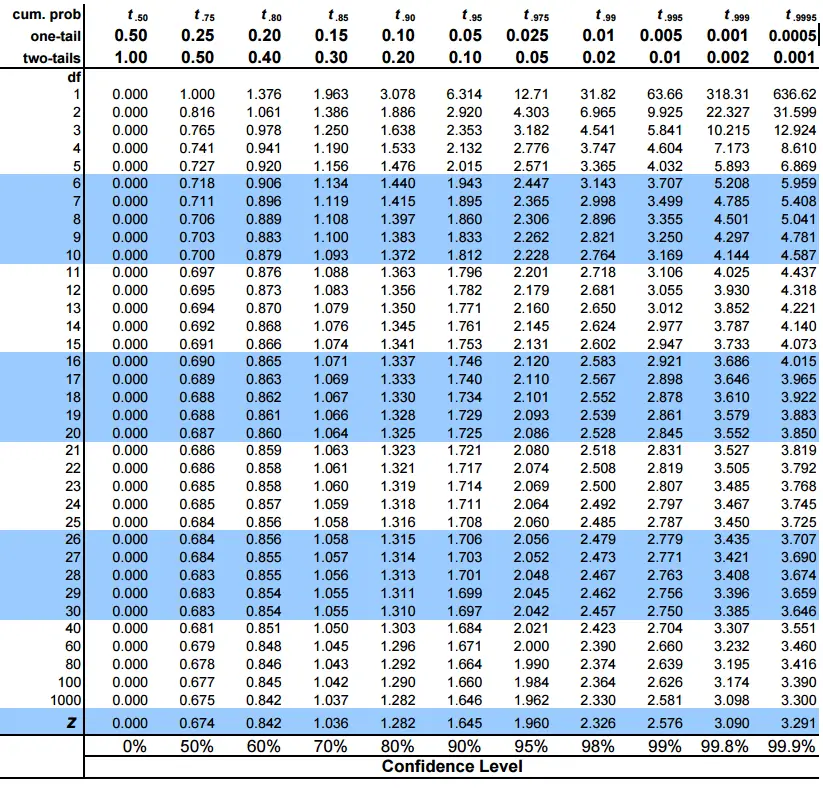
\(\approx 2.042\)
Example:
- The t-score is:
\[ \frac{\bar{x}_t - \bar{x}_c}{\sqrt{\frac{s_t^2}{n_t} + \frac{s_c^2}{n_c}}} = \frac{-10}{3.97} = -2.52 \]
is less than -2.01, so we reject the null hypothesis.
Example:
The p-value is:
\[ 2*P(T_{47} < -2.52) = 0.015 \]
Example:
- The p-value is less than 0.05, so we reject the null hypothesis
- The drug has an effect on blood pressure
Example:
- The confidence interval is:
\[ -10 \pm 2.01*3.97 = -10 \pm 8.0 \]
- The confidence interval is (-18, -2)
Confidence Intervals not Crossing
- If the confidence intervals for the means do not cross, then the difference in means is statistically significant
- But it doesn’t mean that if they do cross, the difference is not significant.
- Redo this previous example
Example:
- The confidence interval for the control group is (with df=21):
\[ 120 \pm 2.080*\frac{10}{\sqrt{22}} = 120 \pm 4.03 \]
- The confidence interval for the treatment group is:
\[ 110 \pm 2.093*\frac{15}{\sqrt{20}} = 110 \pm 6.6 \]
Example:
- The confidence interval for the control group is (115.97, 124.03)
- The confidence interval for the treatment group is (103.4, 116.6)
The confidence intervals cross, but the difference in means is still significant.
Summary
- The key here is that it ultimately depends on the variability of each distribution.
Example: Deworming
- Worm infections (hookworm, roundworm, whipworm, schistosomiasis) affect over 1 billion people, mostly in developing countries.
- Infections cause fatigue, malnutrition, and school absenteeism.
Economic & Policy Implications
Why Worm Infections Reduce School Participation
Fatigue & anemia → Kids too weak to attend.
Stomach pain & diarrhea → Frequent absences.
Cognitive effects → Harder to focus & learn.
Community spread → More infections = fewer kids in school.
Long-Term Impacts (Follow-up Studies)
📈 Higher earnings & employment in adulthood.
📈 Treated children moved into higher-paying sectors.Policy Takeaways
✅ Mass deworming is a highly cost-effective intervention.
✅ Health interventions can improve education outcomes.
✅ Spillover effects justify government & NGO funding for free treatment.
The Study (Kenya, 1998-2001)
- 75 primary schools in Busia, Kenya.
- Randomized phase-in design:
- Group 1: Dewormed in 1998 & 1999
- Group 2: Dewormed in 1999
- Group 3: Control, dewormed in 2001
- Group 1: Dewormed in 1998 & 1999
- So you can compare:
- Group 1 vs. Group 3
- Group 2 vs. Group 3
- Group 1 vs. Group 3
Treatment
- Schools with high infection rates received:
- Albendazole (every 6 months) for geohelminths.
- Praziquantel (annually) for schistosomiasis.
- Albendazole (every 6 months) for geohelminths.
Results
Health & Spillover Effects
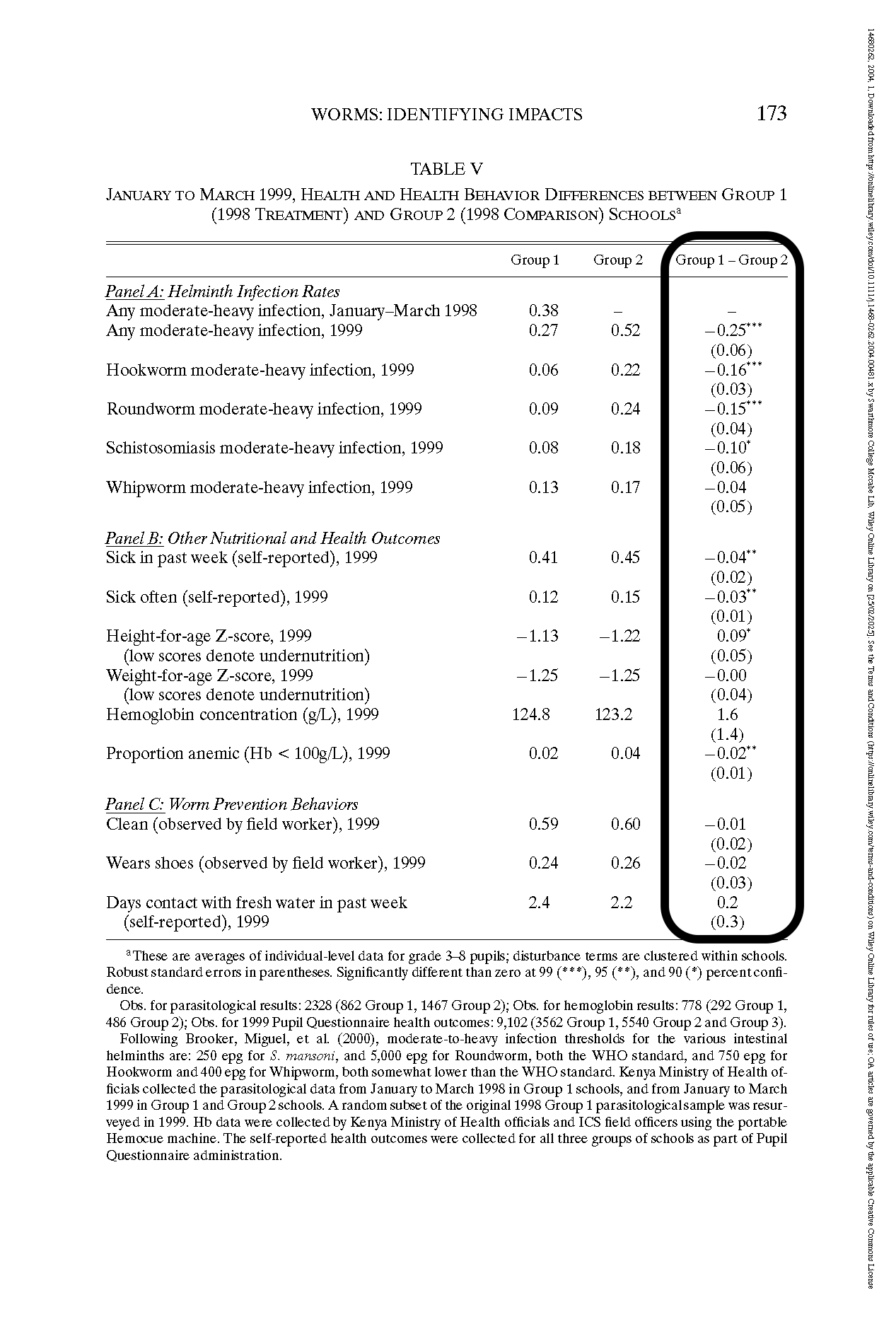
✅ Infection rates dropped significantly in treated schools.
✅ Untreated children in treatment schools & nearby schools also benefited.Education Outcomes
📉 Absenteeism fell by 25% in treated schools.
📉 Younger children saw the biggest gains in attendance.
❌ No significant improvement in test scores.Cost-Effectiveness
💰 Cost per extra year of school: $3.50
💰 Deworming cheaper than school meals or cash transfers.
Checking for Balance
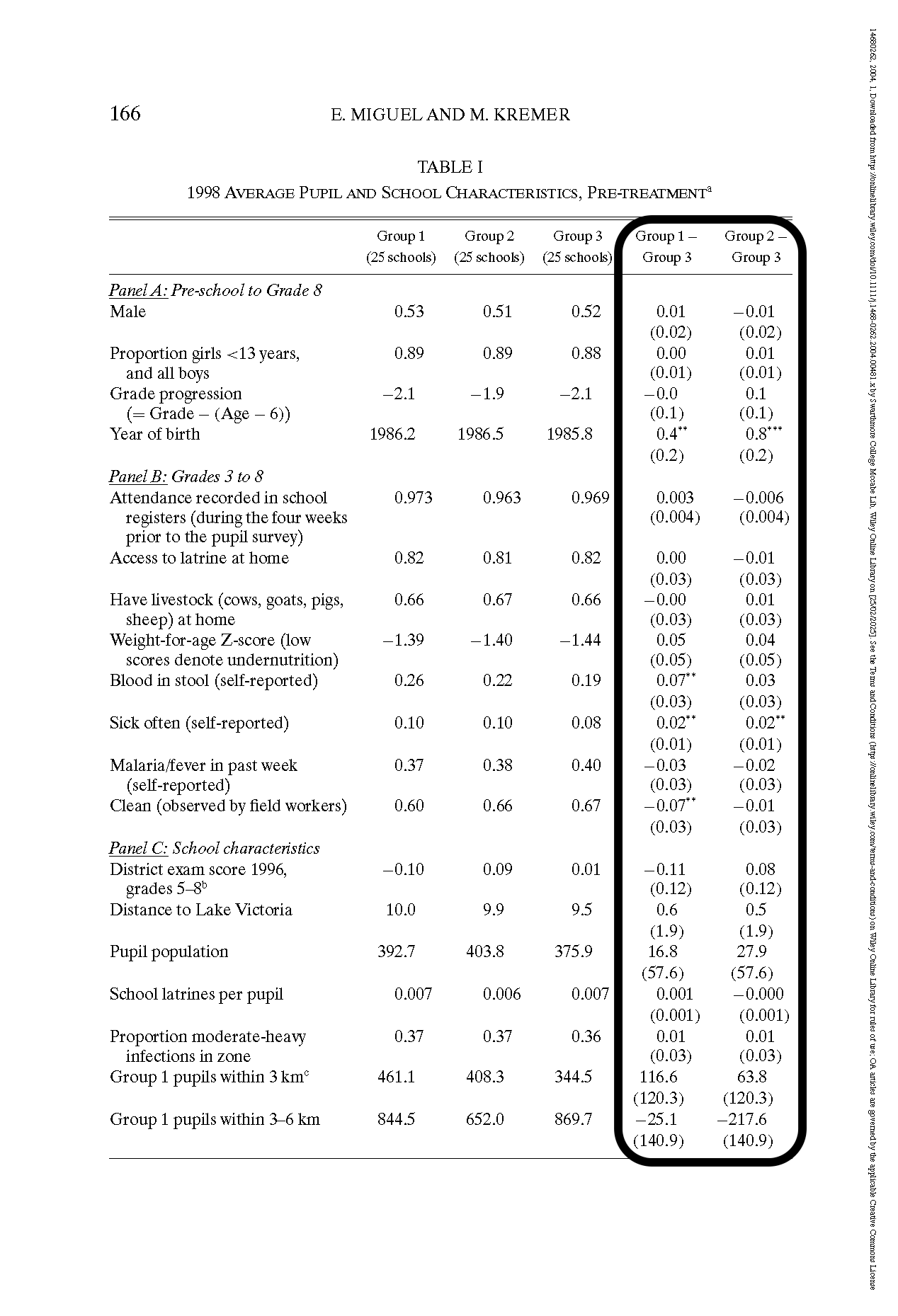
- Oftentimes a way to check for randomization is to check for balance.
- This means that characteristics of the treatment and control groups that are not affected by the treatment are the same.
- Note that it is necessary, but not sufficient
- If randomization is successful, then there is balance, but not the other way around
Checking for Balance
 {.width=200%}
School Participation
 {.width=200%}
Matched Sampling
- With a matched sample, you can compare the means of the treatment and control groups
- Or perhaps it shows the effects of the same unit before and after treatment
- This design often leads to a smaller sampling error than the independent-sample design because variation between sampled items is eliminated as a source of sampling error.
Example
A state government wants to evaluate two different job training programs for unemployed workers. They randomly assigned participants to either Program A or Program B, and then tracked their employment outcomes over 6 months.
To control for individual characteristics, they matched participants across the programs based on factors like age, education level, and prior work experience - with each participant in Program A having a matched counterpart in Program B. The government wants to determine if there is a difference in mean employment rates between the two programs. Use a 0.05 level of significance to analyze the data shown in the next slide.
Example
| Participant Pair | Employment Success (Months) | ||
|---|---|---|---|
| Program A | Program B | Difference | |
| Pair 1 | 32 | 25 | 7 |
| Pair 2 | 30 | 24 | 6 |
| Pair 3 | 19 | 15 | 4 |
| Pair 4 | 16 | 15 | 1 |
| Pair 5 | 15 | 13 | 2 |
| Pair 6 | 18 | 15 | 3 |
| Pair 7 | 14 | 15 | -1 |
| Pair 8 | 10 | 8 | 2 |
| Pair 9 | 7 | 9 | -2 |
| Pair 10 | 16 | 11 | 5 |
Example
In this case, we can calculate the mean of the difference:
\[ \bar{d} = \bar{X}_t - \bar{X}_c = \frac{7 + 6 + 4 + 1 + 2 + 3 - 1 + 2 - 2 + 5}{10} = 2.7 \]
The standard deviation of the difference is:
\[ s = \sqrt{\frac{\sum{(d_i - \bar{d})^2}}{n-1}} = 2.9 \]
Example
The hypotheses are:
\[ H_0: \mu_d = 0 \]
\[ H_1: \mu_d \neq 0 \]
The level of significant is 0.05
The test statistic is:
\[ \frac{\bar{d} - \mu_d}{s/\sqrt{n}} = \frac{2.7-0}{2.9/\sqrt{10}} = 2.94 \]
The critical value is: T-TABLE
Since \(2.94 > 2.262\), we reject the null hypothesis.
Proportions
- We can also test differences in proportions.
- We can use the normal distributions as long as
\[ np_1 \geq 5 \]
\[ n(1-p_1) \geq 5 \]
\[ np_2 \geq 5 \]
\[ n(1-p_2) \geq 5 \]
Interval Estimate
- The confidence interval for the difference in proportions is:
\[ (p_1 - p_2) \pm z_{\alpha/2}\sqrt{\frac{p_1(1-p_1)}{n_1} + \frac{p_2(1-p_2)}{n_2}} \]
Hypothesis Tests (for no difference)
- The null hypothesis for a two-tailed test is:
\[ H_0: p_1 - p_2 = D_0 \]
The alternative hypothesis is:
\[ H_1: p_1 - p_2 \neq D_0 \]
For a right-tailed test:
\[ H_0: p_1 - p_2 <= D_0 \]
\[ H_1: p_1 - p_2 > D_0 \]
For a left-tailed test:
\[ H_0: p_1 - p_2 >= D_0 \]
\[ H_1: p_1 - p_2 < D_0 \]
Tests for Equality
- For each of these tests, we are testing for equality of proportions, meaning our null hypothesis assumes that \(p_1 = p_2=p\).
The standard error under this assumption is:
\[ \sqrt{p(1-p)(\frac{1}{n_1} + \frac{1}{n_2})} \]
And the pooled estimator is a weighted estimate of the different proportions by their sample size:
\[ \bar{p} = \frac{n_1p_1 + n_2p_2}{n_1 + n_2} \]
Giving us a test statistic:
\[ \frac{p_1 - p_2}{\sqrt{\bar{p}(1-\bar{p})(\frac{1}{n_1} + \frac{1}{n_2})}} \]
Example
Market Research Associates is conducting research to evaluate the effectiveness of a client’s new advertising campaign. Before the new campaign began, a telephone survey of 150 households in the test market area showed 60 households “aware” of the client’s product (0.4). The new campaign has been initiated with TV and newspaper advertisements running for three weeks.
A survey conducted immediately after the new campaign showed 120 of 250 households “aware” of the client’s product (0.48). Can we conclude, using a 0.05 level of significance, that the proportion of households aware of the client’s product increased after the new advertising campaign?
Example
The null hypothesis is:
\[ H_0: p_1 - p_2 \leq 0 \]
\[ H_1: p_1 - p_2 > 0 \]
The test statistic is:
\[ \bar{p}=\frac{250(.48)+150(.40)}{250+150}=\frac{180}{400}=.45 \]
\[ s_{\bar{p}_1-\bar{p}_2}=\sqrt{.45(.55)\left(\frac{1}{250}+\frac{1}{150}\right)}=.0514 \]
\[ z=\frac{(.48-.40)}{.0514}=\frac{.08}{.0514}=1.56 \]
The p-value would be defined by:
\[ P(Z > 1.56) = 1 - P(Z < 1.56) = 1 - .9406 = .0594 \]
Since the p-value is greater than 0.05, we fail to reject the null hypothesis.